Meal Planning App vs Food Delivery App: Which Saves More Time, Money, and Macros?
TL;DR
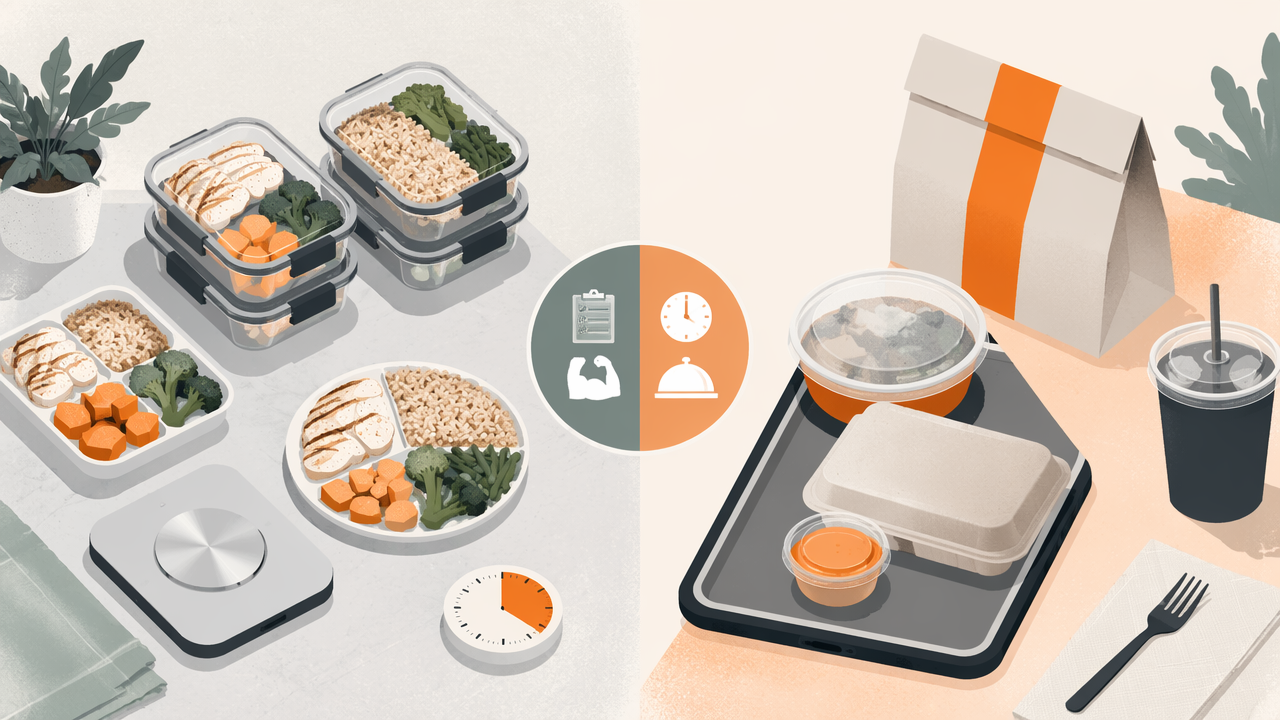
Meal planning apps usually fit macro tracking, grocery control, and weekly prep better, while food delivery apps fit one-off convenience and zero cooking. The strongest choice depends on whether the main goal is immediate food, predictable nutrition, or lower-effort weekly dinners.
The meal planning app vs food delivery app decision comes down to control: delivery solves the next meal, while planning solves the week. A food delivery app connects diners with restaurants, stores, or couriers for prepared food orders. A meal planning app organizes recipes, portions, nutrition targets, and shopping lists before cooking starts. For macro-conscious users, athletes, families, and meal preppers, Dinecraft adds an AI layer that builds weekly plans around calorie and macronutrient targets instead of treating dinner as a last-minute order.
Table of Contents
What is the difference between a meal planning app and a food delivery app?
A meal planning app helps plan meals before cooking, while a food delivery app helps order prepared food from a restaurant, store, or delivery company. The difference is timing and control: planning apps manage recipes, nutrition, and groceries; delivery apps manage ordering, payment, courier logistics, and arrival.
Meal planning app: software that turns nutrition goals, recipes, schedules, and grocery needs into a plan.
Food delivery app: software for ordering prepared food through a restaurant, store, courier service, or independent delivery company.
Key insight: food delivery reduces cooking effort for a single meal, while meal planning reduces decision fatigue across several days.
Core job-to-be-done comparison
| Need | Meal planning app | Food delivery app |
|---|---|---|
| Immediate dinner | Requires ingredients or prep | Strong fit |
| Weekly structure | Strong fit | Weak fit |
| Macro precision | Stronger when nutrition data is validated | Often inconsistent by restaurant |
| Family coordination | Helps plan portions and shopping | Helps satisfy separate cravings |
| Grocery list | Usually built in | Usually absent |
| Cooking effort | Required | Minimal |
Food delivery is useful when time is scarce and no cooking can happen. Meal planning works better when repeatability matters, such as hitting protein goals, planning lunches, or avoiding daily menu decisions.
How do meal planning apps and food delivery apps compare in 2026?
Meal planning apps win on nutrition control, grocery organization, and repeatable routines, while food delivery apps win on speed and low cooking effort. In 2026, the practical choice depends less on app design and more on whether the household needs a single ready-made meal or a planned eating system.
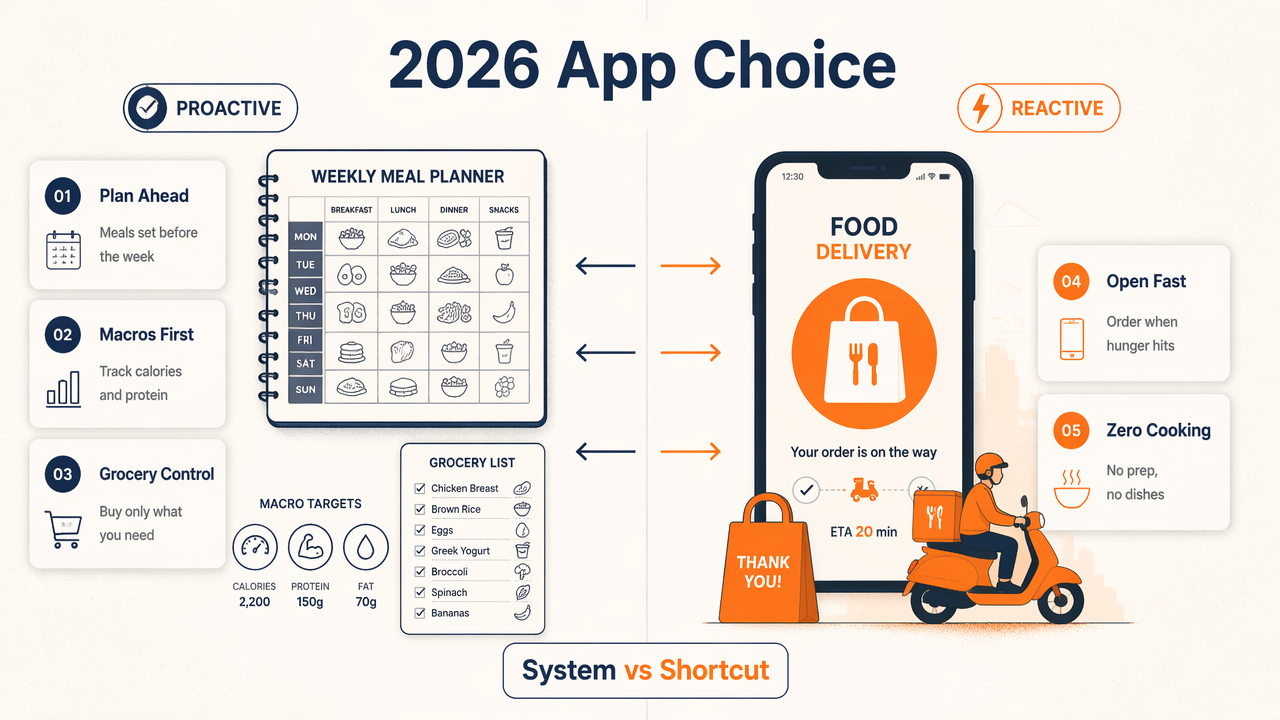
The food app market has split into two habits. One habit is reactive: open a delivery app when hunger has already arrived. The other is proactive: set meals, ingredients, and macros before the week starts.
The 2022 American Diabetes Association and European Association for the Study of Diabetes consensus report discusses individualized nutrition and health management in type 2 diabetes care, which supports the broader point that food choices often need personalization rather than generic meal selection (Diabetes Care report).
Decision table for busy households and macro trackers
| Factor | Meal planning app | Food delivery app | Better fit |
|---|---|---|---|
| Cost control | Grocery-based planning makes cost easier to forecast | Fees, tips, menu markups, and minimums can vary | Meal planning |
| Nutrition accuracy | Strong when tied to validated ingredient data | Depends on restaurant disclosure and portion consistency | Meal planning |
| Macro control | Can plan protein, carbs, fat, and calories before cooking | Harder to adjust precisely after ordering | Meal planning |
| Time today | Requires cooking or prep time | Fastest when available nearby | Food delivery |
| Time this week | Reduces repeated decisions and grocery trips | Repeats ordering decisions | Meal planning |
| Variety | Depends on recipe library and preferences | Many cuisines available instantly | Tie |
| Shopping-list convenience | Often creates grocery lists by recipe | Not designed for grocery planning | Meal planning |
A practical split works for many households: meal planning handles breakfast, lunch, and most dinners, while delivery stays reserved for schedule disruptions.
When is a meal planning app the better choice?
A meal planning app is better when nutrition targets, grocery efficiency, repeatable routines, and family coordination matter more than instant convenience. It suits macro tracking, athletic performance, weight management, allergy-aware cooking, and weekly meal prep because the plan forms before ingredients are bought.
Macro-focused users need more than recipe inspiration. Protein targets, calorie ranges, portion sizes, and allergen exclusions need to align across several meals, not just one dinner.
The Dinecraft platform is built for that structured use case. It creates weekly meal prep plans around calorie and macronutrient targets, uses USDA-validated nutrition data, and can generate aisle-sorted shopping lists. For recipe planning depth, the Dinecraft recipe library shows how meals can be organized with ingredients, pictures, and macros.
Best-fit scenarios for planning ahead
- Athletes and lifters: consistent protein and calorie targets across training days.
- Macro trackers: planned portions before cooking, rather than estimating after eating.
- Busy families: fewer repeated dinner debates and fewer missing ingredients.
- Meal preppers: batch-friendly recipes and consolidated grocery lists.
- Health-conscious eaters: allergen-aware planning and more visibility into ingredients.
Research by Davies, Aroda, Collins, and colleagues in the 2022 ADA and EASD consensus report also emphasizes individualized management in diabetes care (Diabetologia version). For people managing nutrition closely, that supports using tools that make food choices easier to personalize.
How Dinecraft handles this
Dinecraft handles meal planning by combining AI-generated recipes, macro targets, USDA-validated nutrition, allergen-aware preferences, and shopping-list automation in one workflow. The goal is not just finding a recipe; the goal is building a week of meals that matches a defined nutrition target.
A user seeking a high-protein dinner could plan around a recipe such as a grilled chicken quinoa power bowl, then fit the rest of the day around the remaining calories and macros.
Decision rule: when nutrition accuracy matters more than immediate arrival, planning first usually beats ordering fast.
When is a food delivery app the better choice?
A food delivery app is better when immediate convenience matters more than cost control, ingredient transparency, or macro precision. It fits travel days, late work nights, limited kitchen access, illness, group cravings, and situations where cooking or grocery shopping is unrealistic.
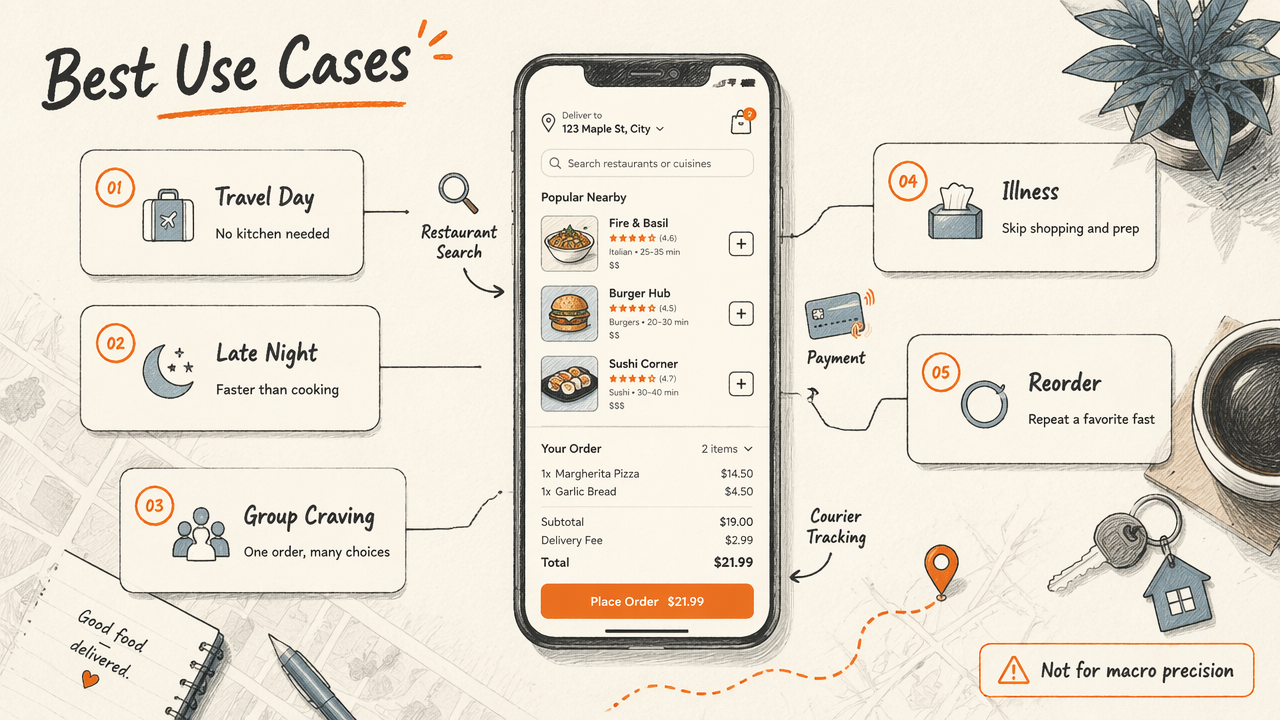
Delivery apps reduce friction. Restaurant selection, payment, courier tracking, and reorder history all happen in one place. That convenience has real value when the alternative is skipping a meal or making a rushed choice with limited ingredients.
Still, food delivery is not designed as a nutrition-planning system. Restaurant portions can vary, customizations may not map cleanly to macro goals, and the final meal may differ from the listed description. For people tracking calories closely, that uncertainty matters.
Delivery works best for these moments
- No kitchen access: hotels, offices, travel, or temporary housing.
- Urgent schedule gaps: meetings, errands, childcare, or late work.
- Social ordering: multiple people want different cuisines.
- Occasional variety: restaurant meals add novelty to a planned week.
- Recovery days: cooking is not practical due to illness or fatigue.
The strongest role for delivery is backup, not default. Used selectively, it can protect a routine. Used constantly, it can make budgeting, grocery planning, and nutrition consistency harder to manage.
What should macro-conscious users choose?
Macro-conscious users should usually choose a meal planning app as the default and keep food delivery as a backup option. This approach gives better control over calories, protein, carbs, fats, allergens, and grocery decisions while preserving convenience for unusual days.
A simple framework helps separate preference from need:
- Choose planning when the goal is precision.
- Choose delivery when the goal is speed.
- Choose planning when meals repeat across the week.
- Choose delivery when the situation is temporary.
- Choose planning when grocery efficiency matters.
Mental load also matters. A 2021 paper in The Lancet Psychiatry examined COVID-19 mental health impacts and responses, showing how daily stressors can strain routines (Lancet Psychiatry paper). Meal decisions are smaller than clinical stressors, but reducing repeated choices can still make daily eating easier to manage.
Weekly decision framework
| Primary goal | Recommended default | Why it fits |
|---|---|---|
| Hit macros | Meal planning app | Meals can be built around targets |
| Spend less predictably | Meal planning app | Groceries are easier to plan than repeated orders |
| Avoid cooking tonight | Food delivery app | Prepared food arrives without kitchen time |
| Feed a family all week | Meal planning app | Recipes and shopping lists reduce friction |
| Add restaurant variety | Food delivery app | More cuisine options on demand |
| Prep lunches | Meal planning app | Portions can repeat cleanly |
A strong weekly system can include both tools, but not with equal roles. Planning should carry the normal routine; delivery should cover exceptions.
For a macro-friendly dinner example with higher variety, meals such as gochujang honey-glazed salmon with rice and broccoli show how planned meals can still feel restaurant-inspired. More examples are available on dinecraft.app.
FAQ: Meal planning app vs food delivery app
A few common questions come up when comparing planned cooking with delivery ordering. The answers depend on goals, but the same pattern appears often: delivery is strongest for convenience, while planning is strongest for control.
Is a meal planning app cheaper than a food delivery app?
A meal planning app is often easier to budget because meals are tied to grocery purchases rather than separate restaurant orders, courier fees, tips, and changing menu prices. Exact savings depend on location, store prices, restaurant choices, and household size, so a fair comparison should use a full week of meals rather than one dinner.
Can food delivery apps work for macro tracking?
Food delivery apps can support macro tracking when restaurants publish reliable nutrition details and portions stay consistent. The challenge is that substitutions, sauces, cooking methods, and serving sizes can change the final numbers. Macro-focused users usually get more predictable results from recipes built around measured ingredients and validated nutrition data.
Are meal planning apps only for people who cook every day?
Meal planning apps are not limited to daily cooking. Many users plan batch meals, leftovers, freezer meals, or simple repeatable breakfasts and lunches. The value comes from deciding ingredients, portions, and meals ahead of time, even when cooking happens only a few times per week.
Which option is better for families?
Families usually benefit more from meal planning when the goal is fewer decisions, fewer grocery gaps, and more predictable dinners. Food delivery can still help during unusually busy nights or when different people want different meals. A mixed approach often works best, with planned meals forming the base routine.
Conclusion
The meal planning app vs food delivery app choice is really a choice between short-term convenience and long-term control. Delivery solves a meal quickly, but planning makes calories, macros, groceries, allergens, and family routines easier to manage over a full week.
For most macro-conscious users, athletes, meal preppers, and busy families, the best next step is to plan the regular week first, then reserve delivery for true exceptions. Dinecraft can support that structure with AI meal plans, USDA-validated nutrition, personalized recipes, and aisle-sorted shopping lists. A faster weekly planning routine can start at dinecraft.app.