AI Meal Planner With Shopping List: What to Look For in 2026
A good ai meal planner with shopping list does more than suggest dinner: it removes the weekly math of calories, macros, servings, leftovers, and groceries. Tools like Dinecraft are part of a shift from simple recipe apps toward planning systems that connect nutrition targets with real shopping behavior. Research on generative AI, including a 2024 IEEE Access review of GPT applications and challenges by Yenduri, Ramalingam, and Selvi, shows why these tools are improving fast: language models can interpret preferences, constraints, and instructions in a way older meal databases could not (IEEE Access, 2024).
What is an AI meal planner with shopping list?
An AI meal planner with shopping list is software that creates meals from your goals, then converts those meals into a grocery list with quantities, categories, and sometimes store-aware organization. The best versions account for serving sizes, pantry items, allergies, budgets, cuisines, and nutrition targets instead of producing a generic recipe queue.
AI meal planner: A digital tool that uses artificial intelligence to generate meal plans from user inputs such as calories, macros, preferences, allergies, schedule, and available ingredients.
Shopping list generator: A feature that combines all planned recipe ingredients into one grocery list, ideally grouped by aisle and adjusted for portions.
Key insight: The planning value is not the recipe suggestion alone. The time savings come from connecting recipe choice, nutrition math, and grocery execution in one workflow.
Core terms that affect real meal prep
- Ingredient consolidation: Combines repeated ingredients across recipes, such as adding all chicken breast amounts into one total.
- Serving-size scaling: Adjusts ingredient quantities when you cook for 1, 2, 4, or more people.
- Pantry awareness: Removes or flags items you already have at home.
- Macro preservation: Keeps protein, carbs, fat, and calories close to your targets when recipes change.
- Aisle sorting: Groups groceries by sections such as produce, dairy, meat, frozen, and pantry.
Competitor pages in the current search results show the category moving in this direction. Grocery AI emphasizes in-stock ingredient checks and organized lists, FoodiePrep promotes pantry management and smart shopping lists, and Supperhero positions itself as a combined planner, recipe organizer, grocery planner, and shopping-list maker.
How does AI turn weekly meals into a usable grocery list?
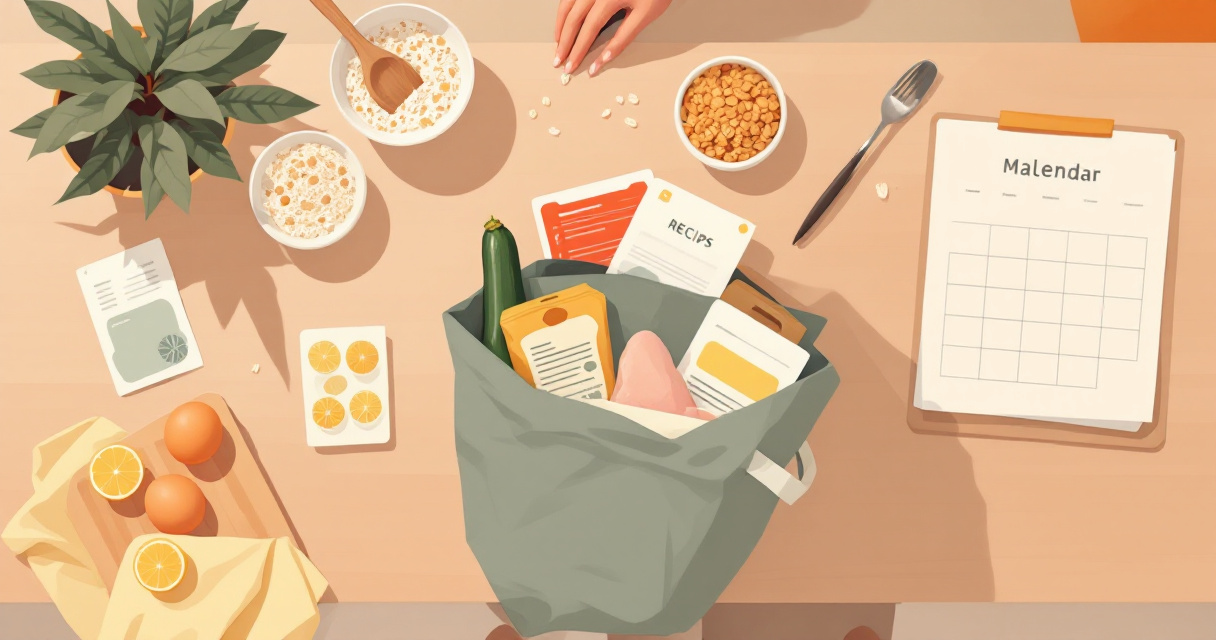
AI turns weekly meals into a usable grocery list by selecting recipes, scaling portions, merging duplicate ingredients, subtracting pantry items, and grouping the final list by shopping category. In practice, the best workflow is a sequence of checks rather than a single recipe prompt.
A practical 6-step workflow
- Set constraints: Enter calories, macros, allergies, excluded foods, preferred cuisines, and number of servings.
- Generate meals: Ask for breakfasts, lunches, dinners, snacks, or meal-prep batches.
- Validate nutrition: Check whether each meal fits calorie and macro targets.
- Scale servings: Adjust recipes for household size or prep containers.
- Merge ingredients: Combine duplicate items across all meals.
- Sort the list: Group ingredients by aisle or store section before shopping.
A plain chatbot can perform parts of this workflow, and one 2025 competitor article in the search results tested ChatGPT for a week of meal planning. The practical issue is consistency: a general chatbot may create appealing menus, but it does not always maintain a structured pantry, reusable recipe library, or validated nutrition pipeline unless the user manages those checks manually.
Where automation saves the most time
The biggest time savings come from boring but error-prone tasks: adding quantities, converting servings, spotting duplicate ingredients, and keeping nutrition aligned when you swap foods. This matters for busy families because one missed staple can break a dinner plan. It matters even more for athletes, where a swap from rice to pasta or chicken breast to salmon can shift macro totals.
A 2021 Sensors paper on smart mobility technologies reviewed how connected systems use data, automation, and user context to improve real-world decisions (Sensors, 2021). Meal planning apps are a different category, but the same principle applies: the tool becomes useful when it connects recommendations to the next action.
Which features matter most in a meal planning and grocery app?
The most important features are nutrition accuracy, ingredient consolidation, pantry tracking, serving-size scaling, allergen controls, and an aisle-sorted list. Recipe variety is helpful, but planning accuracy matters more when the goal is repeatable weekly eating.
Feature comparison rubric for 2026
| Feature | Why it matters | Best for |
|---|---|---|
| Macro and calorie targets | Keeps plans aligned with body composition or performance goals | Athletes, macro trackers |
| USDA-validated nutrition data | Reduces reliance on rough recipe estimates | Precision meal prep |
| Ingredient consolidation | Prevents duplicate grocery entries and quantity mistakes | Families, batch cooks |
| Aisle-sorted shopping lists | Makes store trips faster and less scattered | Busy shoppers |
| Pantry awareness | Avoids buying items already at home | Budget-conscious households |
| Allergen-aware planning | Filters unsafe ingredients before recipes are built | Families, sensitive diets |
| Serving-size scaling | Adjusts quantities for household size | Couples, families, meal preppers |
| Recipe import or library | Keeps favorite meals reusable | Routine planners |
Many apps lead with attractive recipes, but the deciding factor is whether the system can protect your constraints after edits. If you increase protein, remove dairy, or cook for six instead of two, the plan and list should update together.
Red flags to avoid when choosing a tool
- The app gives recipes but no combined grocery list.
- Ingredient amounts do not update when servings change.
- Nutrition appears as broad estimates with no data source.
- Allergy filters depend only on recipe titles or user memory.
- The list is not grouped, so shopping still requires manual sorting.
- Substitutions change calories or macros without warning.
Planning rule: If the app cannot explain what changed in the recipe, grocery list, and nutrition totals, it is not fully solving weekly meal prep.
How Dinecraft handles macro-based meal plans and aisle-sorted lists
Dinecraft handles meal planning by building weekly recipes around calorie and macronutrient targets, then generating grocery lists designed for practical shopping. The Dinecraft platform is built for two common use cases: simple family meal planning and more precise macro-focused planning for athletes, fitness enthusiasts, and structured meal preppers.
What makes the planning approach different
Dinecraft uses a multi-agent pipeline to find, refine, and validate recipes against user targets. That matters because meal planning is not one decision. A useful plan has to match taste, nutrition, allergies, servings, and grocery practicality at the same time.
The app also uses USDA-validated nutrition data, which is a stronger foundation than casual macro estimates. For someone tracking protein, carbs, fat, and calories, that difference can affect whether a week of meals actually matches the plan on paper.
Who should choose which type of planner?
| User type | Better fit | Reason |
|---|---|---|
| Macro tracker | Macro-first planner | Needs calories and macros preserved across the week |
| Busy family | Simple weekly planner | Needs fast dinners, servings, and groceries |
| Athlete | Validated nutrition planner | Needs repeatable meals with tighter targets |
| Pantry-focused shopper | Pantry-aware grocery app | Needs to reduce duplicate purchases |
| Recipe collector | Recipe library app | Needs saving, tagging, and reuse |
Dinecraft sits strongest where macro planning and grocery execution overlap. If your main need is saving recipes from websites, a recipe organizer may be enough. If your main need is hitting nutrition targets while still getting an organized grocery list, a macro-aware planner is the better choice.
What should you expect from AI meal planning in 2027?
AI meal planning in 2027 will likely become more adaptive, more pantry-aware, and more connected to real shopping behavior. The next step is not just better recipe text; it is tighter feedback between what you planned, what you bought, what you cooked, and what you actually ate.
Likely improvements coming next
- Better pantry memory: Apps will remember staples, expiration dates, and common household purchases.
- More reliable substitutions: Swaps will preserve calories, macros, allergens, cooking method, and cost more consistently.
- Smarter leftovers: Plans will account for batch cooking and next-day lunches automatically.
- Family preference learning: Systems will learn which meals get repeated, skipped, or edited.
- Accessibility-aware planning: Tools may better support older adults and households with limited mobility by reducing store trips and planning friction.
A 2023 BMC Geriatrics paper examined mobility determinants among older adults, which is relevant because food planning often depends on shopping access, transportation, and daily function (BMC Geriatrics, 2023).
How to evaluate newer AI features
Treat new features as useful only if they reduce a real step in your week. A beautiful meal photo is nice, but a correct grocery quantity is more valuable. Ask whether the feature helps you decide, shop, cook, track, or repeat the plan.
For a hands-on starting point, visit dinecraft.app and test a plan against one real week of meals. Use your normal constraints: budget, family size, training schedule, allergies, dislikes, and the foods already in your kitchen.
FAQ
AI meal planning questions usually come down to accuracy, shopping usefulness, and how much control the user keeps. These answers cover the practical concerns people have before trusting software with a full week of meals.
Can an AI meal planner replace a dietitian?
No. An AI meal planner can organize meals, estimate or validate nutrition, and build shopping lists, but it does not replace medical nutrition care. If you have diabetes, kidney disease, eating disorder history, pregnancy needs, or clinical nutrition requirements, use AI planning as an organization tool and consult a qualified professional.
Are AI-generated grocery lists accurate?
They can be accurate when the app scales servings, merges duplicate ingredients, and uses structured recipe data. Lists are less reliable when generated from loose prompts, because quantities, package sizes, and pantry items may be missed. Always review staples, spices, oils, and items you already own before shopping.
What is the best AI meal planner for macro tracking?
The best choice for macro tracking is a planner that starts with calories, protein, carbs, and fat rather than adding nutrition after recipes are chosen. Look for validated nutrition data, macro-preserving substitutions, serving control, and weekly totals so you can adjust the plan before cooking.
Do these tools work for families with allergies?
They can help, but allergen handling must be explicit. Choose a planner that lets you exclude allergens before recipes are generated, not after. You should still read labels and ingredient lists, especially for packaged foods, cross-contact warnings, sauces, spice blends, and substitutions.
Conclusion
A useful ai meal planner with shopping list should connect your nutrition goals to the grocery cart, not just hand you recipes. Start by choosing one week, entering your real constraints, and checking whether the tool preserves macros, scales servings, consolidates ingredients, and sorts the list by aisle. If you want macro-aware weekly planning with validated nutrition and practical shopping lists, try Dinecraft with your next meal prep cycle.